
Nothing matched that search. Try a shorter word, or send us your opening dimensions and a photo and we will answer directly.
Barn doors – general
What types of barn doors do you sell?
What types of barn doors do you sell?
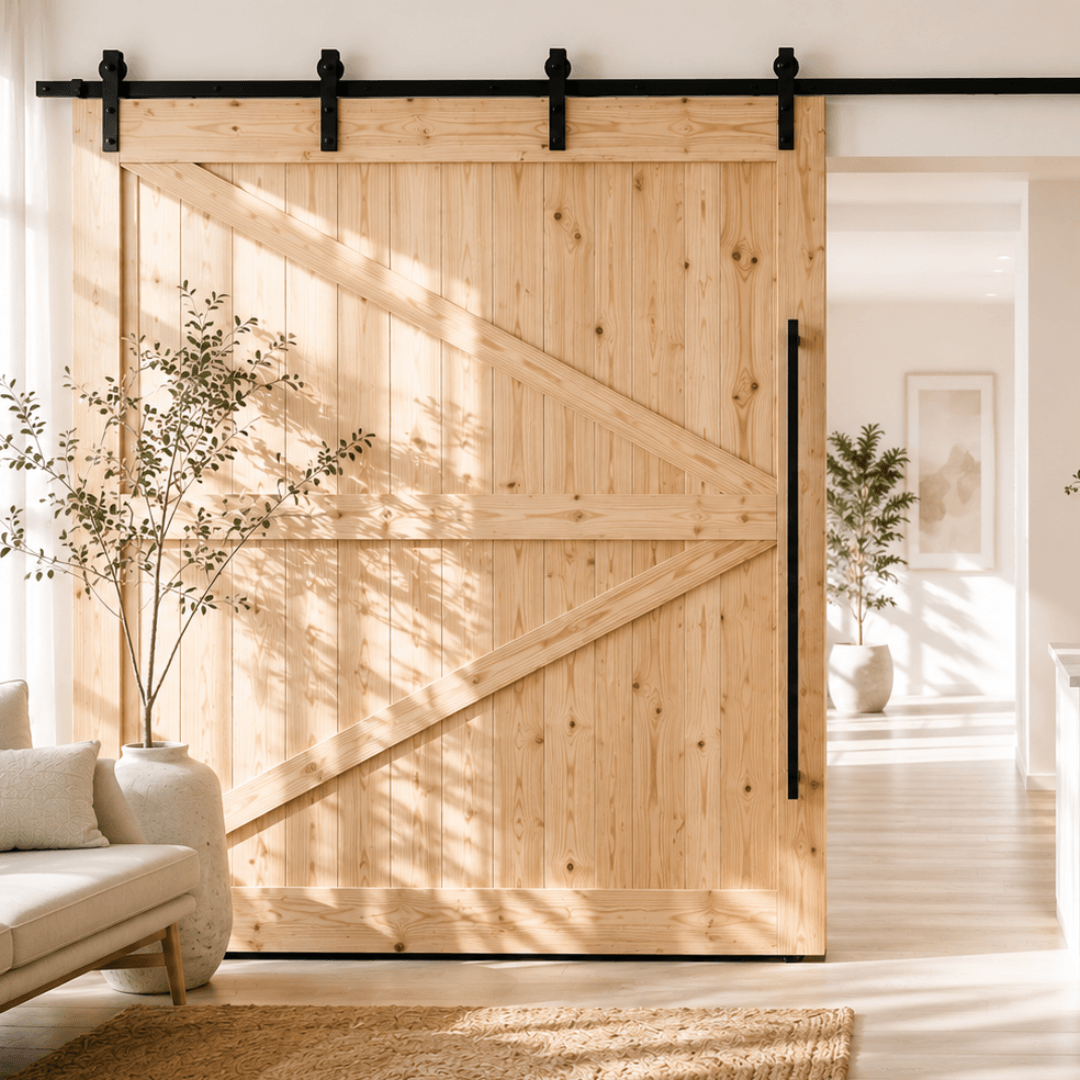
We carry a wide range of barn doors, including solid timber barn doors, painted barn doors, French glass barn doors, louvred barn doors, herringbone barn doors, bifold barn doors and resin barn doors. Selected styles are available in multiple sizes and finishes to suit a wide range of Australian homes.
Can barn doors be used as room dividers?
Can barn doors be used as room dividers?
Yes. Barn doors can work well as room dividers because they slide along the wall rather than swinging into the room. They can be used to separate open-plan living areas, close off a home office, or add privacy to a bedroom or ensuite without taking up floor space.
How do I choose the right barn door for my home?
How do I choose the right barn door for my home?
The main things to consider are the size of the opening, available wall space, your interior style, the level of privacy required and how much light you want to let through.
Solid timber doors can suit rustic, coastal and natural interiors, while painted doors work well in modern and Hamptons-style homes. Glass doors are a good option when you want to maintain light flow between rooms.
Are sliding barn doors soundproof?
Are sliding barn doors soundproof?
Sliding barn doors can help reduce and block sound, but they are not soundproof. Because there are gaps around the door, some sound can still pass through.
Measuring and sizing
How do I measure for a sliding barn door?
How do I measure for a sliding barn door?
Measure the finished opening width and height, ceiling height, architraves or trims that the door needs to cover, and the clear wall space beside the opening where the door will sit when open.
Also check for nearby switches, power points, skirting boards, cornices and other obstructions. Photos of the opening and surrounding wall can help us recommend a suitable door and track.
What size barn door do I need for my opening?
What size barn door do I need for my opening?
A barn door should normally be wider and higher than the finished opening so that it overlaps the opening when closed. The required overlap depends on the door design, handle position, architraves and the level of privacy required.
Send us your finished opening dimensions and we can recommend a suitable door size.
Should I measure the door opening or the existing door?
Should I measure the door opening or the existing door?
Measure the finished wall opening rather than relying only on the size of the existing door.
How much wall space is required beside a barn door?
How much wall space is required beside a barn door?
A single sliding barn door generally needs clear wall space approximately equal to the door width on the side where it opens.
Double doors need suitable space on both sides unless a bypass or another multi-door system is used. Check for switches, windows, air-conditioning controls and other obstructions before choosing the opening direction.
How much space is needed above the opening for the track?
How much space is needed above the opening for the track?
The required clearance varies depending on the track system. Exposed, top-mounted, concealed and ghost-style systems use different mounting positions.
Installation manuals and specifications are available on the relevant hardware product pages.
Custom sizes and made-to-order doors
Do you offer custom-made barn doors?
Do you offer custom-made barn doors?
Yes. Custom sizing is available for selected timber, aluminium-framed glass, concealed, pivot, bifold and other door ranges.
Feasibility depends on the door design, material, panel weight and hardware requirements. For a quote, provide your finished opening width and height, preferred door style, colour, glass type, opening direction, suburb/postcode and photos or drawings.
Can you make extra-tall or extra-wide doors?
Can you make extra-tall or extra-wide doors?
Selected products can be manufactured in larger sizes. Very tall or wide doors may require a different frame, thicker construction, heavier-duty hardware or a double-door configuration.
We will assess the opening and recommend a suitable door and hardware combination.
Can your doors be trimmed or cut to size?
Can your doors be trimmed or cut to size?
It depends on the material and construction of the door. Some timber doors may allow limited trimming, while aluminium-framed glass doors may not.
Trimming can affect the warranty and hardware position, so always check the individual product specifications before cutting a door.
Hardware, tracks and accessories
Does the door price include the track and hardware?
Does the door price include the track and hardware?
Unless the product description states that it is a complete package, the door panel and sliding hardware may be sold separately.
Handles, locks, floor guides, soft-close units and installation may also be separate items. Check the “What’s Included” section on the product page or contact us for a complete package quote.
How do I choose the correct barn door hardware?
How do I choose the correct barn door hardware?
Hardware must be suitable for the door’s width, thickness, weight, material and mounting method. The wall structure and available track length are also important.
Send us the door model or SKU, door dimensions and wall type so we can confirm a compatible system.
Can I use your hardware with a door purchased elsewhere?
Can I use your hardware with a door purchased elsewhere?
Often, yes, provided the door is within the hardware system’s size, thickness and weight limits and has sufficient structural strength at the fixing points.
Glass, hollow-core and very thin doors may require special fittings. Please confirm the full door specifications before ordering hardware.
Can concealed or ghost hardware be fitted to any door?
Can concealed or ghost hardware be fitted to any door?
No. Concealed systems require a compatible door thickness, construction, weight and preparation.
Some doors may require machining or reinforcement, while glass or mirror doors may require a purpose-designed system. Ask us to confirm compatibility before purchasing.
What is the difference between an exposed barn door track and a concealed sliding system?
What is the difference between an exposed barn door track and a concealed sliding system?
An exposed barn door track makes the rail and rollers a visible design feature and is generally straightforward to inspect and service.
A concealed or ghost system hides most of the operating hardware for a minimalist appearance but has more specific requirements for door construction, wall clearance and installation.
Can I add soft-close to my sliding door?
Can I add soft-close to my sliding door?
Soft-close is available for selected track systems, but it is not universal.
Compatibility depends on the hardware model, track length, door weight and available travel. Confirm the track model and door details before ordering or retrofitting a soft-close unit.
Do I need a floor guide for a barn door?
Do I need a floor guide for a barn door?
Yes. A suitable floor or wall-mounted guide keeps the bottom of the door aligned and helps prevent swinging.
The correct guide depends on the door thickness, bottom groove and floor conditions. Where drilling into the floor is unsuitable, a wall-mounted guide may be an option.
Can barn door tracks be shortened or joined?
Can barn door tracks be shortened or joined?
Selected tracks can be cut to length, while others have fixed drilling, stopper or soft-close positions. Wider openings may require a joiner.
Locks, installation and walls
Can a sliding barn door be locked?
Can a sliding barn door be locked?
Yes. Privacy latches and hook locks are available for selected single and double sliding doors.
The right lock depends on the door-to-wall gap, closing edge and whether access is required from one or both sides. Bathrooms, bedrooms and external openings may require different solutions.
Can I use a barn door as a hinged door, or a hinged door as a barn door?
Can I use a barn door as a hinged door, or a hinged door as a barn door?
Some door panels can be adapted, but not every door is suitable for both applications.
Hinged doors require suitable edge construction for hinges and locks, while sliding doors require adequate strength at the hanger fixing points and compatibility with the guide. Confirm the intended operation before ordering.
Do you provide installation?
Do you provide installation?
Installation availability depends on the product and location.
Contact us with your suburb/postcode, selected door or SKU, opening dimensions and site photos so we can advise whether installation or a recommended installer is available in your area.
Can my builder or carpenter install the door?
Can my builder or carpenter install the door?
Most experienced builders or carpenters can install standard timber barn doors by following the supplied instructions.
Concealed systems, large glass panels, pivot doors, bifold systems and complex multi-panel installations may require a specialist. The installer must verify the wall structure, fixings, levels and hardware limits before installation.
What wall structure is required for a barn door track?
What wall structure is required for a barn door track?
The track must be fixed into adequate structural support, such as timber studs, suitable masonry or properly designed reinforcement.
Plasterboard alone is not sufficient. A mounting board or additional blocking may be required where fixing points do not align with the wall structure.
Can a barn door be installed on a brick or concrete wall?
Can a barn door be installed on a brick or concrete wall?
Yes. Many systems can be installed on masonry when the correct fixings and spacers are used.
The installer must assess the wall material, condition, load and drilling locations. Concealed systems may have additional wall and clearance requirements.
Can the track be ceiling-mounted?
Can the track be ceiling-mounted?
Ceiling mounting is possible with selected systems only.
The ceiling structure must support the full door and hardware load, and the fixing method must be suitable for the site. Provide drawings or photos and the door weight so compatibility can be checked.
Can a barn door be installed over existing architraves or skirting boards?
Can a barn door be installed over existing architraves or skirting boards?
Usually, but spacers or a backing board may be required so the door clears the architrave, skirting and handle.
The additional offset also affects the gap between the door and wall. Measure the projection of all trims before selecting the hardware.
Do you provide installation instructions and technical drawings?
Do you provide installation instructions and technical drawings?
Installation guides are available for many products.
Because components can look similar but install differently, use the guide that matches the exact product code and hardware version. Contact us with your order number or SKU if you cannot locate the correct document.
Glass doors, privacy and bathrooms
What is the difference between clear, reeded, frosted and obscure glass?
What is the difference between clear, reeded, frosted and obscure glass?
Clear glass provides the greatest visibility and light transmission.
Reeded glass distorts the view and adds texture but is not fully private at close range.
Frosted or obscure glass provides greater visual privacy while still allowing light through. Privacy can vary depending on lighting, distance and movement.
Which glass is best for a bathroom or ensuite door?
Which glass is best for a bathroom or ensuite door?
Frosted or suitably obscure glass generally provides more privacy than clear or reeded glass.
However, silhouettes may still be visible when the bathroom is brightly lit. Consider the required privacy level, ventilation, locking method and door-to-wall gaps before selecting a bathroom door.
Are glass barn doors safe for internal use?
Are glass barn doors safe for internal use?
Internal glass doors should use safety glass appropriate to their application.
Installation, edge protection and hardware compatibility are especially important because glass panels are heavy. Check the product specification and use installers experienced with glass doors.
Can I order a different glass type or frame colour?
Can I order a different glass type or frame colour?
Selected glass-door ranges offer choices such as clear, reeded, frosted or other decorative glass, together with selected frame colours.
Options vary by model and size. Include the product SKU, preferred glass and frame colour in your enquiry so we can confirm availability and pricing.
Can a glass sliding door be installed into a wall cavity?
Can a glass sliding door be installed into a wall cavity?
Yes, depending on the cavity slider system.
Please check the cavity slider specifications carefully before installation. Door thickness, cavity size and the specific hardware system must be checked to ensure compatibility.
Bifold, pivot and multi-door systems
When should I choose a bifold door instead of a sliding barn door?
When should I choose a bifold door instead of a sliding barn door?
A bifold door can be useful where there is not enough clear wall space for a full-width sliding panel.
A barn door provides a simpler sliding opening action but requires wall space beside the opening. Compare the required clear opening, folded-panel projection, floor guide and furniture layout before deciding.
Can bifold doors be configured to open from either side or from the centre?
Can bifold doors be configured to open from either side or from the centre?
Selected bifold systems allow different panel numbers and opening configurations, but the arrangement must be planned with the hardware and panel sizes.
Provide the finished opening size, preferred stacking side and a sketch showing where you want the handles and panels to fold.
What information is needed for a pivot door quote?
What information is needed for a pivot door quote?
Provide the finished opening width and height, desired door size, glass type, pivot position and a photo of the opening.
What is the difference between centre-pivot and offset-pivot doors?
What is the difference between centre-pivot and offset-pivot doors?
A centre-pivot door rotates near the centre of the panel and creates openings on both sides.
An offset pivot is positioned closer to one edge and behaves more like a hinged door while maintaining a pivot-door appearance. The choice affects the clear opening, furniture clearance and traffic path.
Can you supply double, bypass or multi-panel sliding doors?
Can you supply double, bypass or multi-panel sliding doors?
Yes. Selected products can be configured as double, bypass, triple or other multi-panel systems.
The correct system depends on the opening width, available wall space, desired overlap and whether the panels need to pass each other. Send a dimensioned sketch for assessment.
Finishes and product suitability
What is the difference between primed and painted doors?
What is the difference between primed and painted doors?
A primed door has a preparation coat and normally requires final painting after any necessary fitting and preparation.
A painted door has a factory-applied finish as described on the product page. Always follow the care and finishing instructions, including sealing any permitted trimmed edges.
Can timber doors be stained or painted in another colour?
Can timber doors be stained or painted in another colour?
Selected unfinished or stain-grade timber doors can be finished on site, while pre-painted and veneered doors may have specific limitations.
Check the product description before sanding, staining or repainting, as an unsuitable finish can affect appearance or warranty.
Are internal barn doors suitable for external use?
Are internal barn doors suitable for external use?
No, unless the product is specifically rated for exterior use.
Internal doors may warp or deteriorate when exposed to rain, sun and changing humidity. External openings require an exterior-rated door, suitable hardware, weather protection, sealing and an appropriate locking system.
Can an external barn door be made weatherproof and secure?
Can an external barn door be made weatherproof and secure?
An external sliding door can be designed for improved weather resistance and security, but sliding systems are difficult to seal as tightly as conventional hinged external doors.
The site exposure, head flashing, side and bottom seals, corrosion-resistant hardware, lock and anti-lift protection must all be considered.
Quotes, stock, delivery and after-sales support
How can I get an accurate quote?
How can I get an accurate quote?
Send us the opening width and height, ceiling height, preferred door and hardware, handle design, quantity and delivery postcode.
Photos of the full opening and surrounding wall also help us identify clearance requirements and prepare an accurate quote.
Are your products in stock?
Are your products in stock?
Stock varies by product, size, colour and warehouse.
Check the product page or contact us with the exact SKU, quantity and preferred pickup location. If an item is unavailable, we can advise the estimated restock date or suitable alternatives.
How long does a custom door take?
How long does a custom door take?
Lead times depend on the door type, dimensions, finish, glass, hardware and current production schedule.
Custom orders usually take longer than stocked products. Request a current estimate before ordering, particularly if the door is required for a construction milestone.
Where can I collect my order?
Where can I collect my order?
Collection is available for eligible products from selected warehouse or showroom locations.
Stock is not always held at every location, so confirm the SKU, quantity and collection point before travelling. Wait for pickup confirmation before arranging transport.
Do you deliver barn doors Australia-wide?
Do you deliver barn doors Australia-wide?
Yes. We deliver barn doors, entrance doors and hardware Australia-wide via couriers.
Delivery is available to many metropolitan and regional locations, subject to product size, carrier coverage and site access. Large doors and glass panels may require specialist freight.
How much does delivery cost?
How much does delivery cost?
Freight depends on the destination, product dimensions, weight, quantity and handling requirements.
Enter your delivery details at checkout where available or request a quote using the product SKU and postcode. Remote, restricted-access and oversized deliveries may incur additional charges.
What should I do when my door is delivered?
What should I do when my door is delivered?
Inspect the packaging and product as soon as possible.
Before signing where applicable, note any visible damage and take clear photos of the packaging, label and affected area. Keep all packaging and contact us promptly with the order number so the issue can be assessed.
What if my order is damaged, incorrect or missing parts?
What if my order is damaged, incorrect or missing parts?
Check the consignment as soon as it arrives. If there are issues, contact us promptly with your order number, photos of the product and packaging, and a list of the incorrect or missing items.
Do not install, alter or dispose of the product until you receive instructions, as this can affect the available remedy.
Can I change or cancel an order?
Can I change or cancel an order?
Contact us as soon as possible. Changes may be possible before an item is dispatched or a custom order enters production.
Custom-made, altered or special-order products may have different cancellation conditions. Refer to the current returns and order-change policy for full terms.
Where can I see the doors before buying?
Where can I see the doors before buying?
Selected products are displayed at our showrooms in Melbourne, Sydney and Brisbane.
Displays vary by location, so contact the relevant showroom with the SKU or product name before visiting. Samples and photos may be available when the exact model is not on display.